Category Archives: Tools for the Organic Gardener

Grow So Easy Organic – Best Gardening Resources Online

The Internet is a wonderful place!

It has made the job of finding information on just about anything a whole lot easier.  But sometimes, the Internet can be a bit overwhelming, especially if you are looking for information quickly and if you want a reputable source.

There are more than 20 million sites that talk about organic gardening.  But the odds are that many of those sites aren’t really going to provide information that organic gardeners are looking for.  In fact, a lot of them are just trying to sell you something.

I don’t have a problem with companies trying to sell me something. In fact, I really look forward to the seed and supply catalogues that I get throughout the year.  But I don’t want to read about the latest gadget for growing tomatoes if I’m in the middle of a battle with bugs and I know I’m losing.

I want to get information – fast – and from another gardener that I trust.  So that’s how I chose my favorite gardening web sites.  The sites listed below help me make my garden grow better, arm me for all the little tragedies that come along with life, make me smile,  and warm me on cold winter nights.

I hope you enjoy them.

A Way To Garden
Margaret Roach is truly one of my heroes…not just in the gardening world but in the wider world of surviving.  I met her through her book, The Gardener’s Way.  It was the cover that made me buy it.

Her hands, holding green beans, her nails caked with dirt, the clothing in the background clearly worn for work – all these told me that she was a real gardener.  She was someone who enjoyed digging in the dirt.  I was right.

A Way to Garden was her first salvo in sharing  gardening, expertise that had been refined and honed as the editorial director of Martha Stewart Living.  But it’s when Roach severed ties with Stewart’s empire, moved to upstate New York and started living on the land she bought as a weekend getaway, that she started really digging into dirt and life.

She has written a another book since A Way to Garden – And I Shall Have Some Peace There – about her country life but it’s her blog that I really, truly love.

First of all, the information on her blog is mind-boggling and top-notch.  Secondly, Roach brings in some of the tops gardeners and horticulturists in the country and asks them to share their secrets on everything from raising garlic to pruning berry bushes.

Secondly, Roach’s writing is like music to read – rich, warm, inviting and always, always friendly.  She isn’t trying to prove anything anymore to anyone.  She is really writing from the center of her gardener’s heart and I love getting her newsletter in my inbox!

The Bug Guide 
If you don’t have your own book on bugs and you want to find out what a bug is quickly, check out this site.  A wonderful guide from a reliable source and one that Margaret Roach brought to my attention.

It’s a community website called BugGuide.net – a place where naturalists ranging from amateur to expert share photos of insects, spiders and other bugs and  beasties.

BugGuide.net was started for two purposes – one to expand knowledge about bugs that they say are, “…oft overlooked and oft-maligned.”  But it was also started to help make people more enthusiastic about these critters some of which can be very helpful in the garden.

Roach says Bug Guide, “… has long been a go-to resource for me, but now I’m starting to engage further.”  The site offers a “how to” that makes using the site easier and also tells you how you can participate.

Earth Easy
I know.  This web site sells products…a lot of products.  But, if you look carefully at what they sell, all of their products are geared toward sustainable living and saving the planet.  So I’m interested in what they sell.  And I’m interested in what they are saying.

Earth Easy  is a business that was started by a family that got a chance to try sustainable living, themselves.  Living on a small island, long before sustainable living was a buzzword, Greg Seaman and his family developed techniques, ideas and processes that made their lives rich and full and much less damaging to the planet than a typical family’s lifestyle is.

At Earth Easy, you will find a ton of gardening advice for free.  But what I like even more is the stable of contributing writers that broaden and deepen the information available on this site.

The writers frequently offer tips on how to have a much smaller footprint in our lives.  For example, one of their contributing writers, Geoff DeRuiter, shared his quest to produce just one, small can of trash in a year.

DeRuiter, who is currently pursuing a PhD in Bioenergy and Biocarbon Sequestration did it.  And he offers some solid ideas and information on how all of us could help reduce the waste that streams from our houses to landfills every day.

Earth Easy also sends out one of the better newsletters you can find online.  When their newsletter arrives in my inbox, I take the time to open it, browse through it and read about all the other people and ideas that are out there, in the organic gardening world.

The Garden Rant
So, maybe this isn’t an advice site for gardeners but…it sure has some of the best gardening posts I have read in a long time.  And the writers at Garden Rant aren’t afraid of tackling political problems like Genetically Modified Organisms and “garden police” tearing up back yard gardens because they aren’t up to “code.”

Written by “…4 different gardeners from 4 different corners of the United States,” this blog makes me smile, makes me angry and just plain old makes me come back for more.

The information is spot on, the writing is friendly and easy to read and the topics cover just about everything that an organic gardener and follower of sustainable living could want to know.

The four writers have been raising cane online for 6 years now and they’ve gotten a whole lot of attention from some of the biggest media outlets in the country including the New York Times, The Washington Post and Garden Design Magazine. 

So if you want to laugh and cry and learn about everything that can and does happen to gardeners and in gardening, this is the site for you.

Root Development of Vegetable Plants
Okay, this is a real niche resource.  But this is also what I love about the Internet.  Where else could you find information like this?

Written in 1927 by John E. Weaver and William E. Bruner, two botanists at the University of Nebraska,  Root Development of Vegetable Plants is almost 100 years old but if there is anything you want to know about the roots of any vegetable plant, this is the site to turn to.

I confess I have not read it every page but if I have a question, I gleefully put myself in the hands of Drs. Weaver and Bruner.  And I have learned a whole lot about why my plants do well or do poorly just by understanding the basics of how plants work!

Grow Girls Grow Organic
This Linked In group was started by me about 3 years ago and while it’s small (only 550 or so members), it includes gardeners, growers and friends from around the world.  Less structured and more informal, I welcome anyone who has any interest in gardening from back yard vegetables to rice paddies in Thailand.

Members can post questions, provide answers or just share links to their blogs about their own gardening experiences and backyard lives.  No advertisements are allowed on the blog and I try to police this are carefully – walking the fine line between promotion and providing information on something that might make gardening life easier.

I learned about Foodie Bugle from the Grow Girls Grow Organic members, found Hudson Valley Seed Library and High Mowing Organic Seeds through this group and have picked up quite a few tips on raising some veggies I thought I was already good at.

And I’ve gotten some hearty laughs and made a few friends along the way just from gathering together a group of gardeners from the United States and across the globe.

If you’re already a member of LinkedIn just search for Grow Girls Grow Organic and join in the noise about gardening and living!  Yes, guys are welcome to join too.

Peaceful Valley
Peaceful Valley Farm & Garden Supply, aka Grow Organic, is another organic growing business that started small in 1976 and just kept gaining sales and customers.  Peaceful Valley, named after Peaceful Valley Road in Nevada City, California, is now owned by Eric and Patty Boudier.

Visit their site and you’ll find a lot of excellent information on just about every gardening topic you could wish for.  You can read their online advice and you can watch Patty do video segments on everything from pruning fruit trees to planting tomatoes.

One note of caution:  the last time I ordered, Peaceful Valley had very high shipping rates for its products.  So, although I like the information they share, I don’t like paying almost as much to ship seed garlic as it costs to buy garlic.

If you live West of the Mississippi you may find their shipping rates are lower.  But the East coast pays a premium for Peaceful Valley products that we can get from growers like High Mowing Seed and Hudson Valley.

For the last two weeks, I have shared  books and web sites that are my best friends, especially in winter.  On cold, blustery days, when all the leaves are gone and the ground is covered with snow, I spend time gazing rooting around these sites and reading my books.

I plot and plan what I will grow and draw a garden diagram I know I will never follow.  And I spend quiet hours visiting my online friends and re-reading the books by my old friends that have helped me create this sustainable life of mine.

Next week, I’ll begin delving into the plants I will plan for and plant in 2013.

Grow So Easy Organic – Best Gardening Books

Anybody whose gardened for even a year has favorite books and favorite web sites.  As a 30 year, veteran organic gardener, I have my share of favorites, too.

There used to be dozens of books on my garden shelf.  Today, there are only about 10 of them.  What happened to the rest?

I realized that although I had a ton of books to choose from, I always chose the same, select few when I had a question or needed help.  So I decided to do a bit of clearing up.  When the dust settled, there were a lot more books in the back of the car than on my shelf.

I took the rejects to a used book store where all profits are used to support senior citizens and headed home, having done my good deed for the day.  So, on to the survivors, my favorite gardening books…starting with two books I have and treasure.

The Victory Garden
My life in the dirt began when I tripped over one small book one Saturday morning about 35 years ago. Crockett’s Victory Garden.  I guess I can blame Jim Crockett for all of my gardening crimes.

More than 3 decades old, Crockett’s book is still hailed as one of the best for beginning gardeners and it still has pride of place on my gardening book shelf.

Crockett was a gardener’s gardener.  He didn’t need fancy tools or high-end gadgets.  All this man needed was some soil, some seeds, some sun and rain and he had a garden full of the bounty of nature.

And he was always so easy to listen to and learn from.  No rush, no worries, just good, old-fashioned gardening advice, that’s what you got from Crockett every week on your local PBS station.  And that’s what you’ll get if you can find one of these vintage books for your shelf.

Seed Starters Handbook
The idea of seed starting used to terrify me.  I was beset with questions.  What if I saved the seeds incorrectly and none of them sprouted?  What if the seeds I saved changed from the original plant to a Frankenplant…born out of a cross I didn’t know about?  What if I got great plants and little, tiny fruits?

Saving my own seeds and using them in my garden the next year just wasn’t something I wanted to try.  But I did, with the help of a friend I’ve never met —  Nancy Bubel.

Published in 1988, Bubel’s The New Seed Starter’s Handbook taught me how to save seeds of tomatoes, cucumbers, squash and peppers and use them the following spring.  Getting started was so easy that today, almost 25 years later,  I raise all my own seeds.

In fact, this past summer every plant in my garden — 5 varieties of tomato, 2 types of pepper, 2 of cucumbers and 2 of eggplant and 2 of zucchini – were all started in my basement along with butternut squash, lettuce, spinach, basil and parsley.

Bubel’s techniques are easy.  No special equipment is needed and success is practically guaranteed.  In fact, seed saving is so…natural…I’m surprised everyone isn’t doing it.

Garden Insects of North America; Ultimate Guide to Backyard Bugs
If you grow them (vegetables and fruit), they will come.  Bugs you never imagined in your wildest nightmares will show up one afternoon and you won’t have a clue whether they’re good or bad.

WARNING:  Don’t do what I did.  I wiped out a whole generation of monarch butterflies because I thought the caterpillars on my dill and parsley were “bad.”  So, look before crushing.

It’s really important to, “Know thy enemy.”  Garden Insect of North America Garden Insects of North America: The Ultimate Guide to Backyard Bugs (Princeton Field Guides)  makes it possible to learn about every kind of bug you never thought you wanted to know existed.  Literally.

The images in this book are so good that I turn the pages with my fingertips and only touch the lower corners.  And the images and descriptions will help you identify what’s chewing its way through your garden and give you a flying chance at handling the critter.

Lasagna Gardening
Patricia Lanza’s book entitled Lasagna Gardening, helped me expand my knowledge and increase the size of my garden 5 fold.  There are nooks and crannies in my backyard that were wasted space before I met her and read her book.

Now, every patch of dirt is real estate to grow in.  The inside line of the fence becomes a foot wide bed where beans can be planted and trailed up the fencing.

What’s really great about Lanza’s technique is there is no expensive equipment, no digging, no ploughing, no tilling.  All you have to do is find the space gather materials like shredded leaves, manure, grass clippings, coffee grounds, newspaper and compost and start layering.

Lanza made it easy to do but what she really gave me was the vision to see where I could plant and the freedom to “dig in” without digging at all.

Grow Fruit Naturally
This is my newest book but it is also a book I reach for frequently.  If you decide to grow fruit, Lee Reich is the guy to have in your hip pocket.  Why Reich?

For one thing, the man knows what he’s talking about.  With a doctorate in Horticulture, Reich taught for a while then moved from academic to author, writing books for the everyday gardener and farmer. All of his experience shows in his new book, Grow Fruit Naturally: A Hands-On Guide to Luscious, Homegrown Fruit.

Reich’s knowledge comes from books but it also comes from experience.  He lives on what he calls his “farmden” so named because it’s “…more than a garden, less than a farm.”   And he really, really knows his stuff.

His latest book, Grow Fruit Naturally, could not have come at a better time for me and my backyard orchard.  I especially love his advice on blueberries.

I started growing blueberries without knowing that they are one of the easiest fruits to raise.  In fact, 6 of my bushes are mini-miracles in themselves.  But that’s a story for a later date which I promise to tell in this eBook.

Let’s just say, I planted 12 blueberry bushes in the corner of my back yard instead of 6 and I’ve been harvesting 60 quarts of blueberries every summer…until the summer of 2012.

Weather had something to do with it – 90 degree days in April and 40 degree nights in May.  But somehow, I knew weather was not the only problem.  I was very lucky because, in 2012, one of the best experts on planting and raising bushes and trees shared the fact that blueberry bushes have to be pruned.  Who knew?

Because of this book, I will be heading out into the blueberries in October to do my first pruning, ever!

The Pruning Book
Also by Lee Reich, The Pruning Book: Completely Revised and Updated. The Pruning Book is one I’ve had on my shelf for 15 years.  I bought mine used and have read it a couple of times.  Like his book on growing fruit, Reich shares tons of photographs and drawings that make it easier to learn how to prune any plant.

Reich also shares pruning basics using a step-by-step approach.  He tells you how to prune ornamentals, vines, fruit trees and even house plants.  And Reich offers a special section on pruning techniques for espalier, topiary, bonsai, and pollarding.

By the way, if you like what you read in these Reich books, check out the others he has on sale.  I loved Weedless Gardening and still use the techniques I read in this book in my garden, today.   This wonderful writer and gardener has published many good books.  The books are easy to read, enjoyable and can teach you so much about how to grow and care for plants, vines, shrubs, bushes and trees!

4 Season Gardening
When you are ready to extend your growing season, I can think of no one more helpful than Eliot Coleman and his book, Four-Season Harvest: Organic Vegetables from Your Home Garden All Year Long.  Coleman lives in Maine…so if he can grow vegetables year round, the rest of us should be able to do it, standing on our heads!
As it says in the new edition of this book, “It’s hard to achieve anything new in an endeavor as old as gardening, but Eliot Coleman has done it.”

In this book, Coleman shares every bit of his knowledge, his tools, his advice and his finely honed sense of the cycle of life over the course of a year.  He does so because he wants all of us to benefit from what it has taken him, literally a lifetime to learn.

Clearly written, beautifully illustrated and loaded with photographs, this book is a slow, steady path to move from just gardening in the summer to gardening all year round.  I love the fact that you don’t have to dive in and do it all, all at the same time.

Thanks to Coleman, I now use a small cold frame (made from recycled windows and wood) and have some small plastic tunnels for extending my lettuce crop.  I saved old sheer curtains and sheets and use them to provide protection from frost and I am constantly on the lookout for an old green house that I can buy or move and start growing from November to February.

I love this book and this author because of his generosity of spirit.  And I love Coleman because, as much as any other gardening guru and maybe even a little more, he has given me hope that comes from growing living things.  We don’t have to wait for spring.  We can grow despite the howling wind and falling snow.

Spring will come again but we don’t have to wait for it anymore.

Next week, web sites that I visit on a regular basis for help, advice, information and sometimes, just a little sympathy!

Grow So Easy Organic – Best Resources for Seeds

Fall is always a bittersweet time for most gardeners.

The bitter is the end of the season, the death of all the plants we nurtured from embryo and childhood to full blow adult.  The end of gazing at green dotted with red tomatoes, deep purple eggplant, multi-colored peppers and the deep blue and black of berries on the bush.

The sweet is all in the future – picking out next year’s crops and planning where these special additions will live in your garden.

Which Comes First – Picking or Planning?
This used to be a real conundrum for me so, sometimes I’d pick – sometimes I’d plan and sometimes. I do the exact opposite.  It doesn’t matter to me because I am a lot more relaxed about my garden than I used to be.  And frankly, I’ve learned that it doesn’t really matter…except when it comes to buying your seeds.

There are a whole lot of places you can find and buy seeds.  The market place gets a little narrower if you only want to plant organic seeds and narrower still if you are only going for heirloom seeds.

As an organic gardener, I really do work hard to avoid buying seed from companies that have anything to do with GMO.  I also don’t want my seeds coated with anything or doctored in any way.  Sure, some of the seeds won’t sprout but here’s my philosophy.  If it was meant to grow in my soil, it will.

So when it comes to acquiring seeds, I shop for organic and heirloom.  And I have a few favorite places to buy them.  Since I’ve been buying seeds for many, many, many years, my criteria haven’t changed but some of my sources have, thanks to the Internet and my gardening friends around the world.

Nonetheless, I love opening my mailbox and finding the first seed catalogue in it.  It’s the signal to start browsing all the possibilities and putting in my order.  NOTE:  I know it’s fall.  I know you won’t be planting until February or March (especially if you are a seed starter).  But don’t wait to order. This is especially true if you are buying organic and heirloom seeds.

If you wait to place your order, you may be disappointed.  The latest data indicates that about 50% — half of the population – are doing some back yard gardening.  Ordering seeds now means that you will get the ones you want.

Seed Resources
The internet has opened up a whole new world of where to get the best organic and heirloom seeds.  Here are some of my favorite places to shop and a bit of a reason on why I like them.

High Mowing Organic Seeds
High Mowing Organic Seeds started as a hobby in one man’s backyard garden.  In 1996, founder Tom Stearns planted just 28 varieties of veggies. Converting his tool shed into a seed packing area, he had no trouble selling the seed he grew that first year. The unmet demand for organic seed helped Stearns expand his business, first by renting parcels of land to produce the seed he was selling through a hand-made catalog then by working with select commercial growers.  High Mowing Organic Seeds offers over 600 heirloom, open-pollinated and hybrid varieties of vegetable, fruit, herb and flower seed.

An Aside:  there is another reason that I just love this small and “growing” company.  They share all of their knowledge, including their mistakes and their solutions, freely, literally.  Here’s a good example of the caliber of information High Mowing Organic Seeds posts for everyone to read and learn from.  This article is on growing spinach.  http://www.highmowingseeds.com/blog/spinach-for-winter-production/

So I buy their seeds and subscribe to their newsletter.  A win for me.

Hudson Valley Seed Library
I also buy from a small but growing farm network — Hudson Valley Seed Library.

Like High Mowing Organic Seeds, Hudson Valley offers only organic seed.  Like High Mowing, Hudson Valley started small.  But this is where the comparisons stop.  Hudson Valley offers an online seed library for all gardeners…but it also offers an online seed catalog that is focused on the Northeast.   The idea that was hatched in the town library has grown to a full-blown seed farm where open-pollinated seeds are grown, saved, and packed by hand.

High Mowing has close to one thousand seed library members and it has offers a surprise with every seed packet – heirloom seeds in unique Art Packs designed and created by artists who submit art work for consideration and inclusion in this unique living art gallery.

The farms that make up this group  raise seed you can trust, that’s a given.  But the partners who started this business, Ken Greene and Doug Muller, also use artists to create seed pack covers and donate free seeds to a school garden, community garden, or garden organization  in need.

I love the seeds and I love what the company stands for so I will spend some of my hard-earned dollars with Hudson Valley to get great seeds and support a worthy cause.

Grow Italian
When I want to raise tomatoes and peppers that grace Italian kitchen gardens and enrich the already luscious cuisine of Italy, I only buy Franchi seeds.

This is a U.S.-based business but the seeds only come from Italy.  And what wonderful varieties you can find on their website and

You can get a catalogue, too, but don’t expect a glossy 5 color magazine with gorgeous photography and elegant descriptions.  Grow Italian is mostly a one man operation.

Territorial Seeds
Territorials Seeds is sometimes considered the “granddaddy” of organic and heirloom seeds.

This company started when organic was in its infancy way back in the late 1970’s.  Today, it is still owned by Tom and Julie Johns. They bought the small enterprise in 1985 from its founder Steve Solomon.  Although the business has grown over the last 20 plus years, Tom and Julie have not strayed far from the original course set by Steve.

And Territorial Seeds doesn’t just sell veggie seeds, they share information including a garden planter guide and growing guides that I still use after years of gardening, myself.

Next week, I will be sharing some of my favorite books and web sites for organic gardeners.  Also, beginning next week, Grow So Easy Organic will be published on Saturdays…now that I have a full-time job!

Grow So Easy – Fall Garden Clean Up

How much do you hate cleaning up your garden in the fall?

I used to.  When I  looked out my kitchen window and  saw more brown than green, I would grimace and think, “…next weekend.”  Inevitably, clean up kept getting pushed back by other, more pleasing events like the Hagley Car Show or lunch with friends at il Granaio.

But there comes a moment when I cannot put off the inevitable; I have to clean up the garden and put it to bed for the winter.  And I know I’ll be glad I did in the spring!

Garden Clean Up Tips
Anyone who has gardened for a few years has come up with their own tips and tricks for making garden clean up a bit easier.  Having 30 years of experience behind the hoe, I have discovered a few things that might make life easier for any organic gardener.

Be prepared.  When I go out to clean up, I always bring the tools I’ll need to make it easier.  So my tool bag (actually my wheel barrow) contains:

  1. Scissors – the knots you used to tie up tomatoes will be real tight after a summer of rain and heat.  Trying to pull them off just frustrates the gardener.
  2. Secateurs – if you try to cut back blackberries or blueberries without them, the chances are you’ll do more damage than good.  These small, sharp sheers can cut  through up to an inch of stalk or wood and are always in my bag of tricks.
  3. Baling Twine – picked up at the stable and used to bundle all the leggy tomato, pepper and eggplant carcasses.
  4. A shovel – I sometimes need to coax some of the plants from the ground.  Eggplant and tomatoes get stems more than an inch in diameter and their roots can extend up to 10 feet from the base of the plant.  So, a bit of shovel power comes in handy.
  5. A rake – I prefer the good, old-fashioned garden rake because it’s heavier than a leaf rake and the tines won’t work against me as I rake up fallen tomatoes and peppers.
  6. A bucket – I use an empty kitty litter container and I use it to pick up all the tomatoes that hit the ground at the end of the season.
  7. Garden gloves – I consider these optional.  I always start out wearing them but, inevitably, rip them off about 30 minutes into clean up.  I like the way the dirt feels on my hands.  But the manicure does suffer so it’s up to you whether you wear them or not.

Clearing The Ground
This is always the worst step for me.  I really hate  pulling off tomato cages, cutting vines out of my fence sections and tearing up the roots of the dying plants.  But once I get started, I actually enjoy it!

All plants (except perennials like asparagus, blackberries and herbs) need to be removed, tied and stacked up on the edge of the garden for disposal.  If you clip and clean up herbs at the same time,  you can use the wheelbarrow to hold these bodies.

If the flowers I use for pest control (and to jazz up the greenery), like  marigolds, nasturtiums and petunias, are still blooming, I leave them alone.  If they’re finished, they get tossed in the wheelbarrow, too.

I know some people put these plant bodies in their compost.  I don’t.

NOTE:  If you’re a slow composter like me –letting nature and God do the work for you — you probably shouldn’t put your garden detritus in the bins, either.  Seeds will germinate.  Diseases will survive.  When you spread your compost next year to welcome your new seedlings, you may be welcoming some very unwanted visitors.

One last task remains before you can move from clearing to covering.  If you grew tomatoes, grab a bucket and pick up all of the fallen tomatoes off the ground.  If you don’t you will have a whole lot of baby tomatoes to pull up next year.  This is a gooey task but well worth the effort.

Once the ground is cleared, it’s time to cover it.

Bug Control – A Pre-emptive Strike
During the growing and harvesting season, I don’t use any bug control except what I detailed in Getting Bugged.  However, if it’s been a very bad year for Mexican bean beetles, Asian Beetles, Japanese Beetles and Stink Bugs, just before I cover my garden, I do spray the straw remaining from last year and the ground in my raised beds.

Before you gasp, click unsubscribe and cry, “…traitor,”  know that I use only one product — Pyola.    The active ingredient is pyrethrin which comes from chrysanthemums and is mixed with canola oil.  I use Pyola to control next year’s bugs by killing the larva that are now safely snuggled into my garden ground.

NOTE:  Pyrethrin is a contact poison which quickly penetrates the nervous system of the insect.  It will affect bees and some  beneficials so don’t use it until there is no insect activity in your garden.   Also, pyrethrin is harmful to fish so if you have a pond or your garden borders on a stream, don’t use it at all.

Cornell University’s post on its ExToxNet provides a very thorough idea of what pyrethrin is, how it works and what it might do in the environment.  Read it before you use it so you’ll know if it will work in your garden.  And don’t use it if you don’t have to.

Blanketing the Garden
The last step in garden clean up is to lay down ground cover.  In my garden, that means a recipe of cardboard, newspaper, leaves and straw.

Cardboard goes down first.  I use it mostly to create  a barrier along the edge of my garden where crab grass and pig weed (to name a few of the likely suspects) like to lurk, slip under the fence and set up house in my garden.

I save boxes all year to get enough cardboard for my garden.  And if I come up short, I ask my friends to save boxes from work or home for me.  They know they’ll get plenty of tomatoes, peppers and green beans in payment next year.

Once the cardboard is down, I put down a layer of leaves.  Tip:  I don’t rake leaves.  I just troll the expensive neighborhoods and pick up the leaves their gardeners so nicely bag and put by the curb.

The last layer I put down is straw.  It helps hold the leaves in place.  And it breaks down, enriching my soil and making it better, every spring, for the seedlings to grow and thrive.

I use about 40 bales of straw  to cover everything including the blueberry and blackberry patches, the vegetable garden, raised beds and asparagus.  That may sound like a lot but by next spring, the 18 inches of straw I lay down now will have settled and started to break down.

So that’s my version of garden clean up.  Clean up really isn’t that hard but I avoid it because it signals the end of the growing season and the approach of cold winds and falling leaves.    It also means time for dreaming and planning next year’s garden…

And that’s what we’ll start doing next week.  I’ll share some resources for organic seeds and some tips to help make your next growing season easier and more productive.

Grow So Easy – Garlic – How To Grow & Harvest It

I got lucky when I married Italian because garlic is, was and always will be one of my favorite foods in the kitchen.

And it’s one of my favorites to plant.  Garlic is another crop that basically takes care of itself.

If you get the right cloves to plant then give those cloves a good start in the right soil at the right time, you should harvest enough nice-sized bulbs of garlic to last through the year.

Garlic is easy to grow and has much more taste if it's homegrown.

My garlic harvest for 2012.

Where To Buy
My first thought is to tell you where not to buy.

Don’t pick up garlic at the grocery store and expect to plant it and reap a big harvest.  You might get lucky, but you may also be planting cloves that have been treated not to sprout.

You could try buying garlic at a health food store but there is no way to know how viable it is.  If you want to try to grow garlic that is already growing in the soil in your region, try a farmer’s market.  Someone might be selling their garlic and you could get a good starter crop.

NOTE:  No matter where you get your first garlic bulbs, buy more than you think you will need.  Plant them all.  There are only two of us living here but I plant between 50 and 60 cloves of garlic (10 bulbs) every fall.  Sounds like a lot  because it is.  But it won’t all get used in my kitchen.

I share 10 or 12 bulbs but that still leaves 50 bulbs!  How many cloves can an Italian wife (by association) possibly use?  I actually go through about 35 heads a year.  So what do I do with the 15 left overs?

Most of them go right back into my garden.  I plant them.  I always plant enough so I can use my own garlic to raise my next crop.  There are a couple of reasons for using this method.  My garlic knows my soil.  And it’s adapted to my climate. It grows faster and stays healthier because it is acclimated.

Timing Is Everything
DON’T PLANT GARLIC IN THE SPRING!

If you do, you are doomed to fail.  The garlic cloves you plant are considered dormant.  They have to be exposed to cold temperatures in order for them to begin to grow and change from cloves to bulbs.

If you plant in spring, the bulbs don’t get exposed to low temperatures (32 degrees to 50 degrees for 2 months).  No cold means no bulbs, spindly growth and frustrated gardeners.

Besides, planting in the fall means that Mother Nature gets to do all the work while you sit inside browsing through seed catalogues and dreaming of spring.

Exact timing for planting day depends on where you live and yes, what zone you live in.  In my old Zone (6), garlic was planted on Columbus Day, October 12th.  However, with the slow warming of the earth, garlic planting day has moved back.

In Zone 6b, I don’t put it in the ground until the end of October and, sometimes, even as late as the second week of November.  Put it in too early and it sprouts then freezes.  Again, you could lose your entire garlic crop.

Planting when the world is getting frosty, the snow is falling and the wind is cold  seems wrong and it would be if that’s all you did.  But there’s an easy, cheap trick to keeping your garlic safe through the blustery winter months.

Blanketing Your Garlic
I don’t mean sacrifice one of your blankets and toss it on top of the newly planted garlic bed!  But you do have to cover your babies.

My cheap, easy trick?  Plant the bulbs then mulch with 24” to 36” of straw.  (This works with onions, too, by the way.)

The straw protects the bulbs from the cold, lets them overwinter safely and ensures they will be ready to start growing as early as March.

But once winter is over, it’s really important to uncover the garlic as early as possible so the sprouts don’t rot.  If they rot, you will lose your garlic crop.

Here’s an easy tip for knowing when to uncover garlic (and onions).  When the forsythia bloom, pull back the mulch.  You may even find a few garlic bulbs already sprouted under there.

Depending on your zone, you will probably get a few frosts after you uncover the garlic.  Just toss something over the young plants to protect them.  I use an old queen-sized mattress cover and drape it over the corners of the bed where the garlic is planted.

Harvesting Garlic
How do you know when to pull the garlic up?  Honestly, this has always been a struggle for me.

And the more I researched and read, the more confused I got.  Pull it up on this day/date.  When the leaves on one or two start to brown, push the rest of them over, wait a week and pull them up.  Wait until all the leaves on the plants are brown then pull them up.   Aaaaaaargh…as one our most famous philosophers used to say!

What finally cleared it all up for me was a simple, beautifully written article by one of my favorite garden gurus, Margaret Roach, who clearly understands the garlic harvest conundrum.

Too early, and the bulbs won’t have time to develop to their full size.  Too late and the bulbs will be over ripe, cloves will separate and the harvest won’t store as well.

Here’s the gist of Roach’s advice for harvesting garlic:  Harvest when several of the lower leaves go brown, but five or six up top are still green. Depending on the weather, this typically happens here (New York state) in late July.”

Rip & Regret
A word to the wise: healthy garlic develops a pretty serious root structure.  Do NOT try to pull garlic up by its greenery!  You will break the tops off and the garlic bulbs really need their tops to cure.

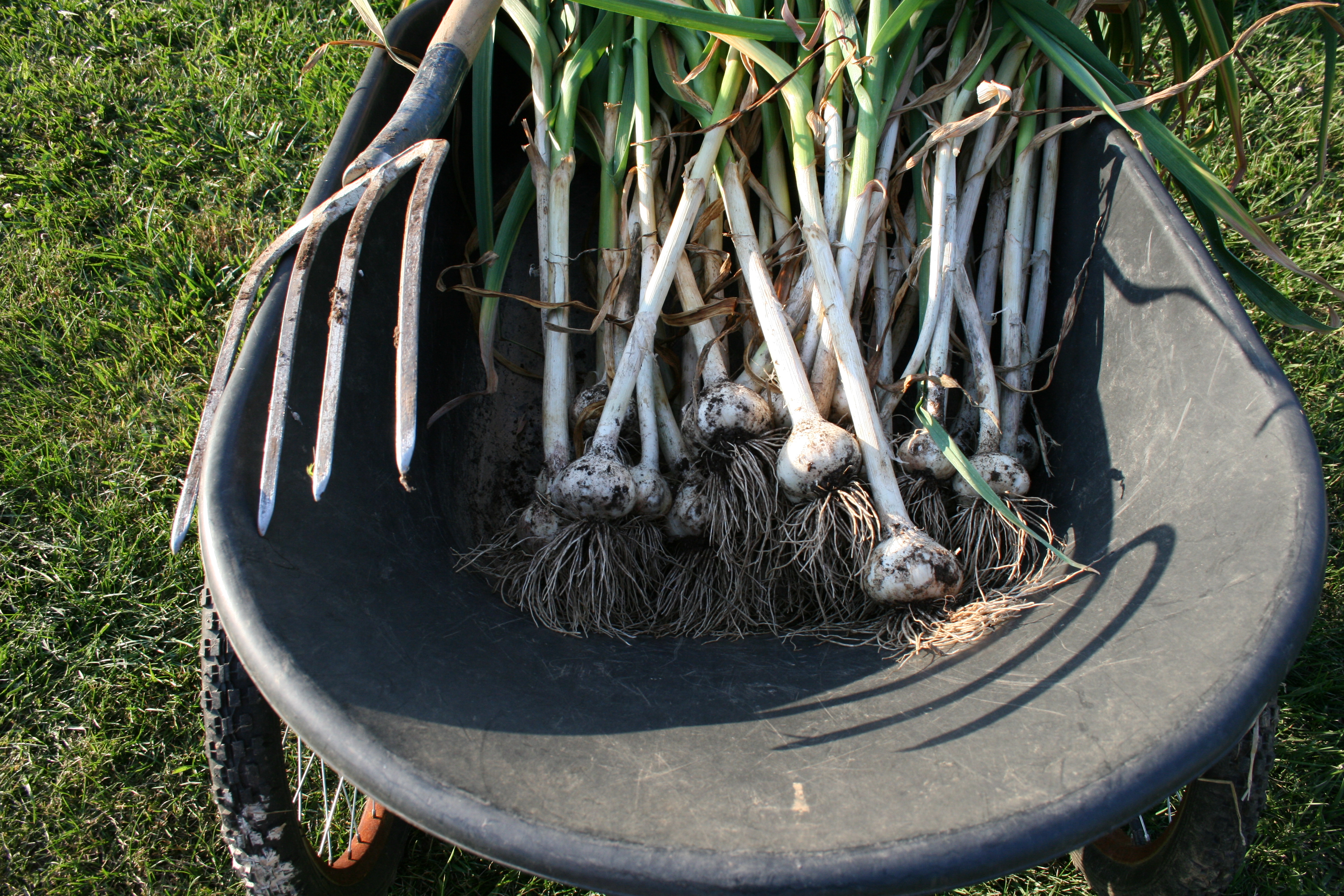
So, what’s the easiest way to pull these babies out of the ground?  With a garden fork – not the hand-held kind.  You want a flat-tined, digging fork like the kind you would use to dig out potatoes, like the one you see resting next to my garlic in my wheelbarrow.

  1. Start about 2 to 3 inches away from the garlic bulb.
  2. Push the tines down into the earth, almost as far as they will go.
  3. Rock the fork front to back and side to side to loosen the dirt around the roots of the bulb.
  4. Keep loosening until you can easily and gently pull the bulb from the ground.
  5. Equally gently, lay the cloves into a wheelbarrow.  Banging them will bruise them.

As soon as all your bulbs of garlic are out of the ground, you need to get them out of the sun and into a nice, dry, temperature controlled space with good air flow.  I use my shed.  I lay down an old sheet, then place the bulbs side by side but not touching.  I want air flow around each bulb.  And if one’s going south, I don’t want it to take the others with it.

Curing Garlic
Once you have them in your controlled drying spot, leave them alone for 6 to 8 weeks while they cure.  (I do check them to make sure none are going bad…). When they are cured, If they’re soft neck, braid away.

If they’re hard neck (what I always raise), you can cut the tops and the hairy roots off and store them inside.  I actually put mine in a big tray and shove the tray under the dresser in my sewing room.

The temperature is moderate in this room (I keep the thermostat at 62 in the winter) and the light is dim under the dresser.  My garlic seems to keep perfectly there.

NOTE:  check the cloves about every 6 weeks, especially if there is any aroma of  “garlic” wafting through the air.  If you can smell the garlic, it means one of the bulbs is probably going bad.  If you leave it in the general population, it may turn other heads bad, as well.

Save 8 to 10 bulbs of your garlic for planting in October and November and enjoy the rest, all winter and spring.

Aside

This winter, according to Accuweather, my Mid-Atlantic zone is running about 10 degrees colder than normal.  I would say so! With wind chills, we have hit  negative numbers like -17 and -24 degrees. For a gardener, sitting inside, listening to … Continue reading

Grow So Easy – Planting Cool Weather Crops Like Beets

One season gardening used to be all I did.  Put in the plants in the spring, harvest in July, August and sometimes in September and clean up in October.  Then the prices of organic produce shot through the roof and I started thinking that there had to be a way to get more out of my dirt than tomatoes, cukes, peppers and eggplant.

My adventure with growing more and longer began a bit late in my gardening life but I’m glad it did.  Truthfully, I probably will never get as far as master gardeners like Eliot Coleman.   who authored a favorite book of mine, Four Season Harvest, but I am enjoying cool weather crops like fresh lettuce, spinach and beets from March through October.


Let’s start this trip with one of my all-time favorites – beets

Beets
My mom raised the absolute best beets I have ever eaten.  Every time I drove to her farm in the far end of Virginia, she would somehow know exactly when I was arriving.  There, on the table, steam rising, butter melting, would be a big bowl of sliced beets, just for me.

But I never planted beets in my own garden.  Not before she died, not after she died.  Then, one day, while browsing through GrowItalian.com, I saw Chioggia beets.  Beautiful, round and ruby-red on the outside but when you cut them open, there are concentric white bands all the way through each slice.

I was in love with beets, again.

Beets Are Easy Peasy
I’ve had beets in my garden now for the last 5 years and think they are among the easiest plants to grow.  But if you Google “growing beets,” you will literally get more than 3 million entries.

Don’t be scared!

There are only a couple of things you need to know to raise not just 1 but at least 2 crops of beets every year. (That’s how many I can grow in Zone 6.)  WARNING: if you ignore what you are about to read, you will get red marbles…that will not cook or eat easy.  I know.  My first crop was used in a game of ringer.

The Dirt
This is almost one of the only requirements of beets and it’s one of the most important.  It’s also the bit of information I didn’t have when I raised my first crop of red marbles.  Beets really, really like loose, well-drained soil. They will put up with a wide range but won’t grow as big or as beautifully.

So do a bit of soil prep if you can. It may take a bit of time and effort but it’s worth it; I know.  And if you get the soil right, it’s smooth sailing to harvest time.

Remove stones since they will hinder growth.  If you’re growing in clay, add compost to loosen the soil and keep the soil from crusting after watering or rainfall.  And make sure your soil is acidic – beets like a pH range of 6.2 to 6.8.

When To Plant
Don’t plant in the middle of your summer season.  Beets won’t like it.  They are a perfect cool weather crop.  Although they can live through the heat (like the rest of us), they prefer a temperatures of 60 to 65 F and bright sunny days but they can also survive cold weather as long as they don’t get caught in a freeze.  So, beets are a great, “long-season” crop.

How To Plant
Beet seeds are outdoor babies from the get go.  As soon as your soil can be worked in the spring, you can plant them.  The seeds aren’t really just one seed – each of these little jewels contains a couple of beet seeds.  Sow the seeds 1/2-inch deep and I drop each seed about 3 inches away from the other seeds.  I also plant in rows about 12 inches apart.

Beets seeds are pretty slow to germinate so make sure you keep the bed moist until you see their little heads peeking out of the soil.  I usually water a bit, every day.  Once they start to pop up through the soil, I keep watering but usually every other day.

Once they are established, just make sure that you don’t let them dry out.  But don’t overwater either.  Too dry or too wet and your beets will not be happy.

Transplanting
TIP:  I don’t thin; I transplant.

Most advice online and in books says you have to thin beets rather than transplant.  Wrong!

Despite what people will tell you, you can transplant beet seedlings and almost double your crop. And it’s easy to do.

I wait until the leaves on the plants are about 2 inches long before I try transplanting.  The night before the big move, I water the bed thoroughly.  Then, early in the morning, armed with a #2 pencil, I head to the raised bed where my beets live.

I look for beet plants that are too close together. Because I’m not be most patient person when dropping seeds in soil, I can usually find 3 or 4 beet babies clumped together.

DON’T PULL THEM OUT ONE BY ONE!

Once I’ve found the baby beet clump I want to move, I gently dig around the whole clump and bring up a shovel full of soil with the beet roots intact.  Then I push my pencil into the ground, making holes spaced about 3 inches apart, for each of the babies.

Teasing the roots apart, gently, (a trick I learned from my Amish neighbors) I drop each beet baby into its own hole, pack dirt gently around it and move on to the next clump.

I have not lost one beet baby using this method and I practically double my yield.  Oh, and beets are a twofer in my garden – I also eat beet greens in salads.  Wait until the leaves are 3 to 4 inches high, then cut a couple off each beet plant.  The beets will keep growing and you’ll have some truly delicious greens for lunch or dinner.

Care & Feeding
Like I said, beets are easy peasy.

I have never fertilized my beets and they grow like champions.  It could be because I enrich my raised beds with a bit of compost every spring.  I do put a bit of mulch – straw – down around the plants once I divide and transplant them.  It helps hold moisture during the hotter, summer days.

Keep The Beets Coming
I plant in March, April, May then hold off until early August when I start putting in seeds, again.  I do that to avoid asking the beet seeds to germinate when the daytime temperature is above 80 degrees.  They don’t like it.  Plant in early August and within 55 to 70 days, you should have your next crop.

Nowadays there are so many varieties of beet to choose from — Early Wonder, Detroit Dark Red, and Red Ace.  You can even add some color to your beet dishes with the lovely striped Chioggia (which started me on my life of beet crime) or Burpee Golden and Albino White

No matter how you slice them…beets are a great addition to any garden.

By the way, one of my favorite resources when I am trying to get solid, informed, basic growing information is the so-called “land grant” colleges like Penn State and Ohio State.  They usually offer fact sheets like the one on beets that was posted by Ohio State.

Next week, another favorite in my fall garden (and another easy one to grow) — lettuce!

Grow So Easy – Fall Planting & Gardening Zones

Fall Planting in August?
We’re not even through summer vacation but if you want to extend your gardening season, you should already have the plan laid out and maybe even put some of those seeds in the ground!

That’s right, late July and early August, especially in my zone – 6b – starts right now!

But before we talk about what to plant, when and why, let’s take a quick look at two maps that will help you buy and grow plants best suited to your home town.

Who Says I Can’t Grow Avocadoes In My Back Yard?
When I first hit the dirt and started planning and planting my garden and grove, I considered it a challenge to be told by nameless people, “You’ll never get avocados (pineapple, artichokes, guava) to grow in this zone.”

Unfortunately “they” were right.

If you live in California or the Florida panhandle, you can grow avocados and other tropical fruits and veggies.  You can’t if you live in Pennsylvania.

With dead plants, bushes and trees piling up in my back yard, I decided that maybe, just maybe, I should look into this thing called “zones.”

In The Zone
If you aren’t familiar with zones, don’t panic.  This isn’t the periodic table of elements.  This is the updated (2012) United States Department of Agriculture (USDA) zone map.

organic gardeners use the USDA zone map to help them choose cold-hardy plants and trees,.

Gardeners have come to rely on the USDA zone map to choose cold-hardy plants and trees,.

Zones aren’t nearly as complicated as some people would like them to be.  They just look intimidating at first glance.    So, here’s how to read this thing.

Find your approximate location in your state.  For example, I live in Southeast Pennsylvania so my color is a medium green.  Then check the chart on the right side of the map.

Based on color and location, my zone is 6b.  The coldest my zone is supposed to get is -5 degrees Farenheit.  Notice the words “…supposed to be”  and take this information with a grain of salt.  It’s a guideline, not a rule.

The USDA zone chart, which has been published since 1960, helps with getting a handle on when you can set out plants without freezing them to death.  And if you look for the zone chart, you’ll find that it’s being used in lots of places that can help you, too.

Seed packets, plants, trees and bushes are usually sold with the same zone chart and the suggested planting times.  Both help you quickly figure out what will live or die in your backyard…based on environment, alone.

Armed with your zone, you could start to make plant choices that work for you. But there’s one other “zone map” you might want to know about before you buy.

Recently (1995 and if you’re talking planting, that’s recent), a new zoned map has entered the gardening scene.  This one, published by the American Horticultural Society (AHS), looks similar the USDA chart but it tracks heat.

Download your copy and start looking it over.  This map tells you how many days per year the temperature in your back yard is over 86 degrees.

So what?  That’s the magic temperature where plants start to suffer from too much heat.  Who cares?  Why should I track heat?

Because it can do as much damage as cold, maybe even more.  Frost kills plants, buds and sometimes even bushes and trees, instantly.  Heat is a little subtler but just as deadly. And heat damage is even worse during a drought.

What should you look for if you suspect the heat is hurting your plants?

The AHS says the damage can appear in several places.  Flower buds wither. Leaves droop. Leaves may turn brown or even white as the chlorophyll disappears.

AHS describes “death by hear” this way; “Plant death from heat is slow and lingering. The plant may survive in a stunted or chlorotic state for several years. When desiccation reaches a high enough level, the enzymes that control growth are deactivated and the plant dies.”

In his new book, Grow Fruit Naturally: A Hands-On Guide to Luscious, Homegrown Fruit ” , Lee Reich calls the AHS map, “…a work in progress” as it was just recently developed and is still being tweaked.  But the heat map is a good guide to understanding how hot it can get in your garden and how much damage heat can do.

And it should help you to start thinking about what might have a better chance of surviving once you put it in the ground.

Next week, armed with what will survive and thrive in the heat and the cold, we’ll get into what is going into the ground in my garden, right now.  Think beets, lettuce and spinach.

Grow So Easy – Gardening without Weeds! Really!!

Weeding is one thing that any gardener swiftly grows to hate.  And the older you get, the less fun it is to land on your knees, bend over and dig the little blighters out.  But not weeding can lead to a whole lot more pain than a sore back or a knee with twinges.

Weeds grow fast and set seeds even faster.  If you see one weed, you can bet that it’s invited about 500 of its closest relatives to join it in the ultimate comfort of your garden.

Deadly Rain
I want to kill weeds too.  And I want to do it quickly and painlessly.  But I won’t do what a lot of other backyard gardeners do.  I won’t reach for the handy spray bottle of herbicide conveniently sold at my local, big box, home improvement store.

Herbicides are fast and deadly.  But they don’t just kill weeds.

Research is beginning to unravel the reasons behind the death of millions of honey bees, worldwide and it looks like the root of the problem are products containing neo-nicotinoids – weed-killing products readily available in this country and in Europe.

The debate over cause and effect is in full swing right now but I’m old enough to remember a similar debate about two weed-killing agents – 2-4-D and 2-4-5T.  Supposedly so safe that as little children, we were given the job of filling weed wands with this chemical, adding water and running through our very big yard, barefoot, killing weeds.

So far, both my brothers have succumbed to brain tumors and my older sister survived ovarian cancer and is now battling kidney cancer.  So that’s one reason why I don’t recommend using any herbicides in any form.

I also live in the country.  Everyone has wells.  Do you really want to poison your neighbors, downstream?  There are days when I consider it (joking) but polluting the water supply just doesn’t seem like a nice thing to do.

The Queen of No Weed Gardening
What do I do to get rid of weeds?

I confess that in the early days of my organic gardening life, when I was still gainfully employed, I bought a flame thrower.  No, really, I bought a flame thrower and used it to burn weeds out. That’s how desperate I was.

But it was expensive, the propane tank was heavy, bulky and an added cost.  And frankly, I never really killed the weeds, just singed them enough to make them angry and hardy!  And I lit my house on fire…but that’s a story for another day.

When I found the method developed by Ruth Stout, a pioneer in organic gardening and, even more importantly, a pioneer in making it so easy, I jumped on board with both feet.  Here’s how she described her system in an interview done by Mother Earth News.

“My no-work gardening method is simply to keep a thick mulch of any vegetable matter that rots on both my vegetable and flower garden all year round. As it decays and enriches the soil, I add more. The labor-saving part of my system is that I never plow, spade, sow a cover crop, harrow, hoe, cultivate, weed, water or spray.  I use just one fertilizer (cottonseed or soybean meal), and I don’t go through that tortuous business of building a compost pile.” 

You can read the full article on Mother Earth News.  Or you can read her book aptly titled Gardening Without Work: For the Aging, the Busy & the Indolent

She has been my gardening guru for years and this book tells you how to suppress weeds but it also contains other organic gardening tips and lots of practical information and ideas that still work in the 21st century.

The Oxymoron of No Kill Weed Killing
Stout’s method may sound ridiculously simple but it works. I spend 4 hours in the fall mulching and about 10 hours in the spring and summer weeding. And my patch is pretty big – 20 feet wide and about 75 feet long.

It can’t get much easier than this.  Every fall I cover my entire garden with wet newspaper and straw – about 8 inches of it piled up on top of the paper.  Weeds (and all their seeds) are buried alive and prepping the garden for the next spring and summer is done.

And guess what?  While you are killing weeds and saving your back and knees, you are also feeding your soil.  All that mulch breaks down and enriches the dirt beneath it.

Sure, some weeds might poke their beady little heads up from time to time but they are few and far between.  All I have to do is just put more mulch on top of them and…they die.  But sometimes, I actually welcome the chance to break out my other secret weapon.

It’s the Fiskar’s Big Grip Garden Knife – the single, best tool I have ever bought and used in my garden.  No weed gets away and because of its design, it’s easy on my hands.  Made of aluminium, this knife comes with a lifetime guarantee and does the job efficiently and effectively.

What an amazing system – very few weeds and enriched soil served with a side order of revenge…and a back that doesn’t ache!

Next week I want to start talking about mid-season and fall planting and all the ways you can extend your garden crop!

How to Go Green: Like Celebrities : TreeHugger

Hey, maybe if going green, living local and growing organic  become popular ideas with big name celebrities, the rest of the world will hop on the band wagon (or hybrid)!

Had to repost this wonderful article from Collin Dunn of How To Go Green fame.  It’s not all about gardening but it is about people who have the money and power to live like rapacious Republicans (you know who they are) but have chosen a different path.

Enjoy!  And remember – weedless gardening is the topic this week.

How to Go Green: Like Celebrities : TreeHugger.

via How to Go Green: Like Celebrities : TreeHugger.