Category Archives: Gourmet Food

When To Plant Veggies

It’s that time of year…finally!

I think I can actually start planning on putting out some of my home-grown plants. Weather in zone 6B has finally moderated. No more wild extremes like 81 degrees on Monday and 27 degrees on Friday night!

We’ve been on a roller coaster ride for temperatures and high (and constant) winds in the Mid-Atlantic states. The weather has made gardening more like a series of fits and starts than planning and planting.

Cold temperatures and high winds stunted the garlic.

Garlic stunted by cold and wind.

My lettuce and kale got burned almost to the ground in spite of having been covered by a tunnel of plastic! Wind swept under one end of the tunnel and flipped it off on night. I didn’t catch it until the next morning and by then, the damage was done. Even my garlic took a hit and that’s hard to do.

But now, it looks like we are getting to the time when something other than kale, beets, lettuce, onions and garlic can be put in the ground so here are some tips for getting your babies and their new “digs” ready.

Prep your soil!

If your garden soil has been covered during the winter, uncover it. I pull straw back about 12 inches from the fences I use to support my plants so the soil can warm up.

If you’re going to amend your soil, adding worm castings or compost (or both), now is the time to turn it and add the amendments. I use 1-year-old horse manure so I have to dig down, put manure in the trench, and cover the manure with about 8 inches of soil. I want to feed my babies, not burn their new roots.

Lay down your soaker hoses. It’s so much easier to put soaker hoses on the ground before you put your veggie plants in so take an afternoon to organize and lay them out especially where you’re going to plant tomatoes, which you don’t really want to spray with water.

Harden them off!

Hardening off your plants does NOT involve tools or torture.  It just means that you have to introduce your transplants to the outdoors, gradually.

Five or six days before you want to put them in the garden, start setting them outside for a an hour a day for 2 days, 2 to 3 hours a day for 2 to 3 days, 8 hours a day for 3 days and only then (and only if it’s not hailing or very windy) do they get their first overnight! Keep an eye on them.  Make sure they have water and are not staked out in high sun or high wind.

NOTE:  when hardening off, stop fertilizing.  If the plants have small flowers or fruit on them, pinch both off.  You want to help transplants direct all of their energy to rooting in the soil before trying to set flowers or fruit.

Plant When It’s Warm!

I also used to hurry and plant my babies by May 7th or 8th. Frequently, the ground was too cold for warm weather crops like tomatoes and peppers and they simply stopped growing for a couple of weeks (or forever in some cases).  Putting plants in the ground too early can be deadly so give the soil a chance to warm while you get your plants ready for the great outdoors.

Remember, plants that I call “Mediterranean”like tomatoes, peppers and eggplant like warm earth and warm air. The optimal air temperature for them to go into the ground is 75 to 85 degrees. In my neck of the woods, that means these warm weather babies are typically transplanted the last week of May, especially if the weather is dicey.

So, even though it’s not quite time to start putting your plants in the ground, you can go out and play in the dirt, yourself. Get your garden ready for the big day! Your babies will thank you.

Growing Bradford Watermelons

I am super excited this year because I am going to try to grow watermelons this summer.  Not just any watermelons…Bradford watermelons.

So, what’s the big deal with Bradford Watermelons?

These are supposedly the sweetest watermelons available on the market today. Their Brix is over 12. Their sweetness is one reason this type of watermelon fell into disfavor with growers and disappeared from the marketplace for almost 100 years.

The watermelons were so sweet that they couldn’t be shipped very far before they began to rot. Hardier watermelons with thicker skins were developed just for distribution and the Bradford watermelon faded from public memory.

So, their sweetness attracted me but I think the reason these watermelons are so special is the back story about their revival.  I love the farm, and the way the great, great, great, great, great, great grandson (also named Nat) took up the mantle and brought this legacy watermelon back to life. (Or it could be the watermelon brandy that Bradford is now selling!)

In any case, I going to try growing a few but a couple of things make this new venture a bit tricky for me.

  1. Taste: I tried raising cantaloupe one year. I successfully grew beautiful plants were covered with large melons…that tasted like dirt! No joke, they were virtually inedible. So, I’m thinking perhaps my soil is not suited to raising melons.
  2. Real estate: watermelon like room to grow. They need real estate. I have room in the backyard but I also have a husband who is not all that thrilled by all the new holes I put in the ground every spring and summer.
  3. The seeds come with fairly long, very detailed planting instructions. I never read instructions. Perhaps I should…

I am going to direct sow these seeds – I got 10 for $10 and gave half away – in late May and will provide updates and pictures – good, bad or ugly – as my watermelon adventure gets off the ground!

Kombucha Recipes

Kombucha is one beverage with many uses.  It is a tasty, “healthy” soda – effervescent and probiotic. Kombucha can also be used in cooking and baking, adding a dollop of flavor to hot cereals, pancakes and even steamed vegetables.

Home-brewed kombucha is easy and inexpensive to make

Probiotic kombucha tastes great.

If you make your own kombucha, you’ll probably find a few more ways to use this healthful sparkling beverage.

I like kombucha without any flavoring, at all but I also like kombucha with everything from blueberries to juniper berries added during the final fermentation.

Combinations of herbs, spices, fruits, and juices that can add flavor to your kombucha are almost endless.  Here are some of my favorite blends, but feel free to be creative and add whatever flavors you enjoy!

Easy combinations include:

  1. Blueberry/Vanilla – whole blueberries and vanilla to tast
  2. Tart Cherry Vanilla – organic tart cherry juice and vanilla
  3. Sweet Beet – organic beet juice
  4. Pomegranate – organic pomegranate juice
  5. Hibiscus flower – dried red hibiscus flowers (which I get from Mountain Rose Herbs)

Here are some more ideas for giving your kombucha that extra bit of flavor:

Elderberry, Rosehip, & Cinnamon
A standby, this is the blend that I make really enjoy. Sometimes, I’ll add Hibiscus flowers or use ginger root instead of cinnamon.

1/3 cup organic dried elderberries
1/4 cup organic dried rosehips
1 tsp organic cinnamon chips

Sparkling Ginger Pear
This recipe is simple, yet delicious.   It’s a light, refreshing, and reminiscent of champagne.  Use whichever fruit is in season: raspberries, blueberries, blackberries, apricots, and peaches are all tasty substitutes for pears.

1 Asian apple or regular pear
1 TBSP dried or fresh organic ginger root

Refreshing Herbal Medley
A perfect blend for the summertime!  This medley is cooling, refreshing, and the addition of Yerba Mate offers a little energy boost.

½ cup organic dried hibiscus flowers
2 TBSP dried organic holy basil (Tulsi)
2 TBSP dried organic peppermint
1 TBSP dried organic ginger root
1 TBSP dried organic Yerba Mate

Flavorings your home brew are only limited by your imagination. Experiment, play and enjoy this wonderful fermented beverage for pennies on the dollar.

How To Make Your Own Kombucha!

Kombucha is one of the hottest probiotic beverages on the market today. You can buy kombucha in just about every health food store and co-op in the country. But you’re going to pay a pretty penny for each 8 ounce glass you drink.

Home-brewed kombucha is easy and inexpensive to make

Probiotic kombucha tastes great.

At a local food exchange, where kombucha is on tap, one glass is $4.00.

All kombucha is is a fermented black tea flavored with organic juices or fruits of your choice and maybe even a few spices. So, when I recovered from sticker shock, I decided to calculate how much a glass of home-brewed kombucha would run.

Would you believe home-brewed kombucha costs about $.31 a glass? Yep, I said 31 cents a glass and that’s using pure cane sugar and premium Sada Chai from the Tao of Tea company.

You can make 8 glasses of kombucha, at home, for the cost of a single glass at the store. That’s why I started making my own kombucha!

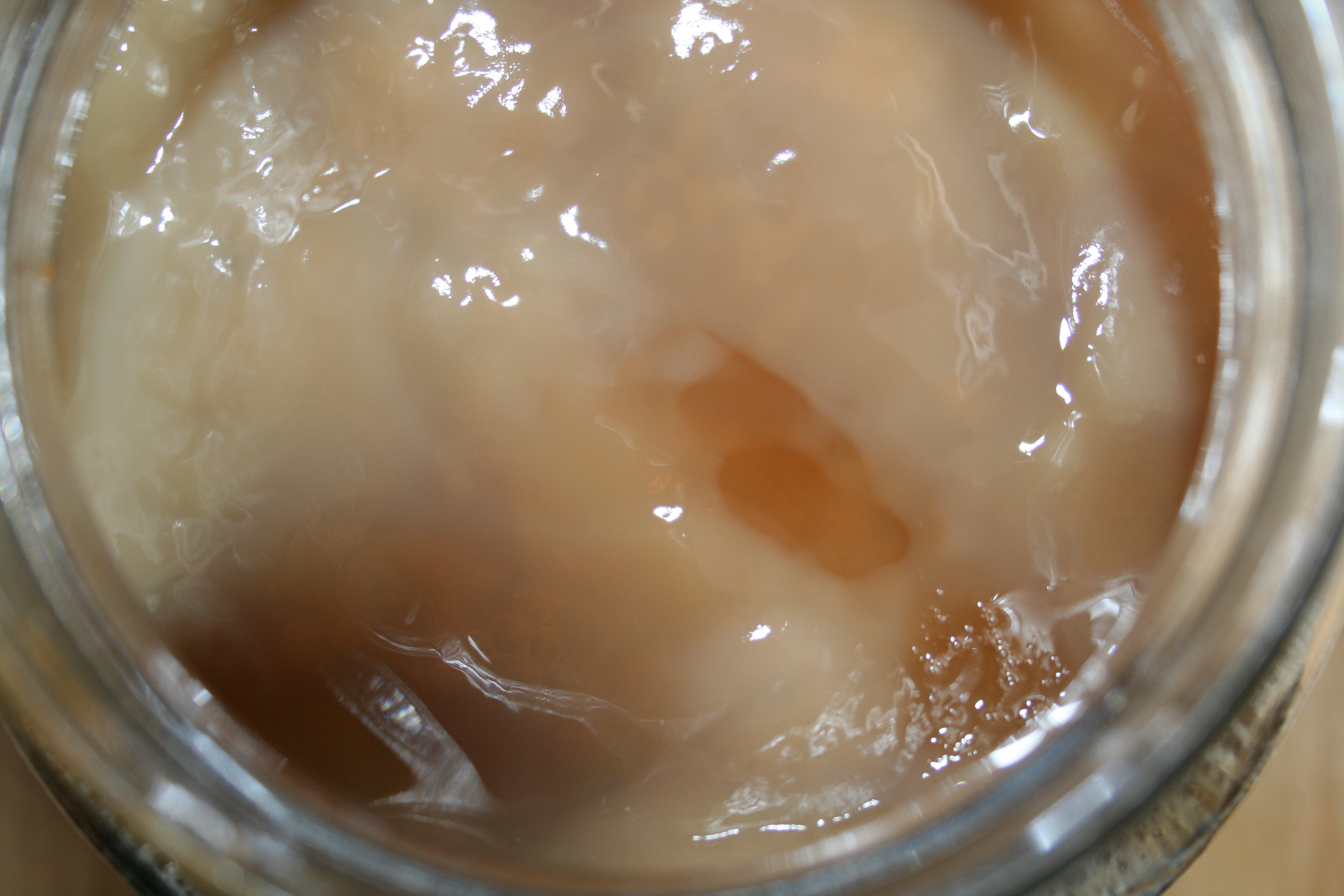
Once you have your SCOBY (Symbiotic Combination of Bacteria and Yeast that you see here) all you need to buy again will be tea and sugar. SCOBYs look a bit like you might imagine the blob looked like in the 1950’s sci-fi thriller. But don’t let the SCOBY’s looks put you off.

This healthy SCOBY is making kombucha.

Healthy SCOBYs look a bit like jelly fish.

This is a powerful and living organism that eats the sugar you put in your black tea, fermenting it and giving you 8 glasses of kombucha for about $2.50.

And she does it in 7 to 10 days!

How do you get started?

It looks a bit daunting but if you follow the directions, it is easy and your kombucha will be delicious!

  1. Bring a gallon of water to a boil, then turn off the heat and immediately add 4 Tablespoons of loose tea and 1 cup of organic cane sugar.  Cover the pot with a lid and let the tea cool to room temperature. If it’s too warm (anything approaching 90°) it will kill the SCOBY.
  2. When the tea is room temperature (check this with a thermometer) strain out the tea leaves, and pour the liquid into your glass or ceramic gallon container. Add your SCOBY and 1-2 cups of kombucha starter liquid it shipped in. NOTE: this is for the first batch you make.  The batches thereafter, just pour off and bottle all but 2 cups of kombucha then pour the fresh tea right into the gallon jar with your SCOBY .

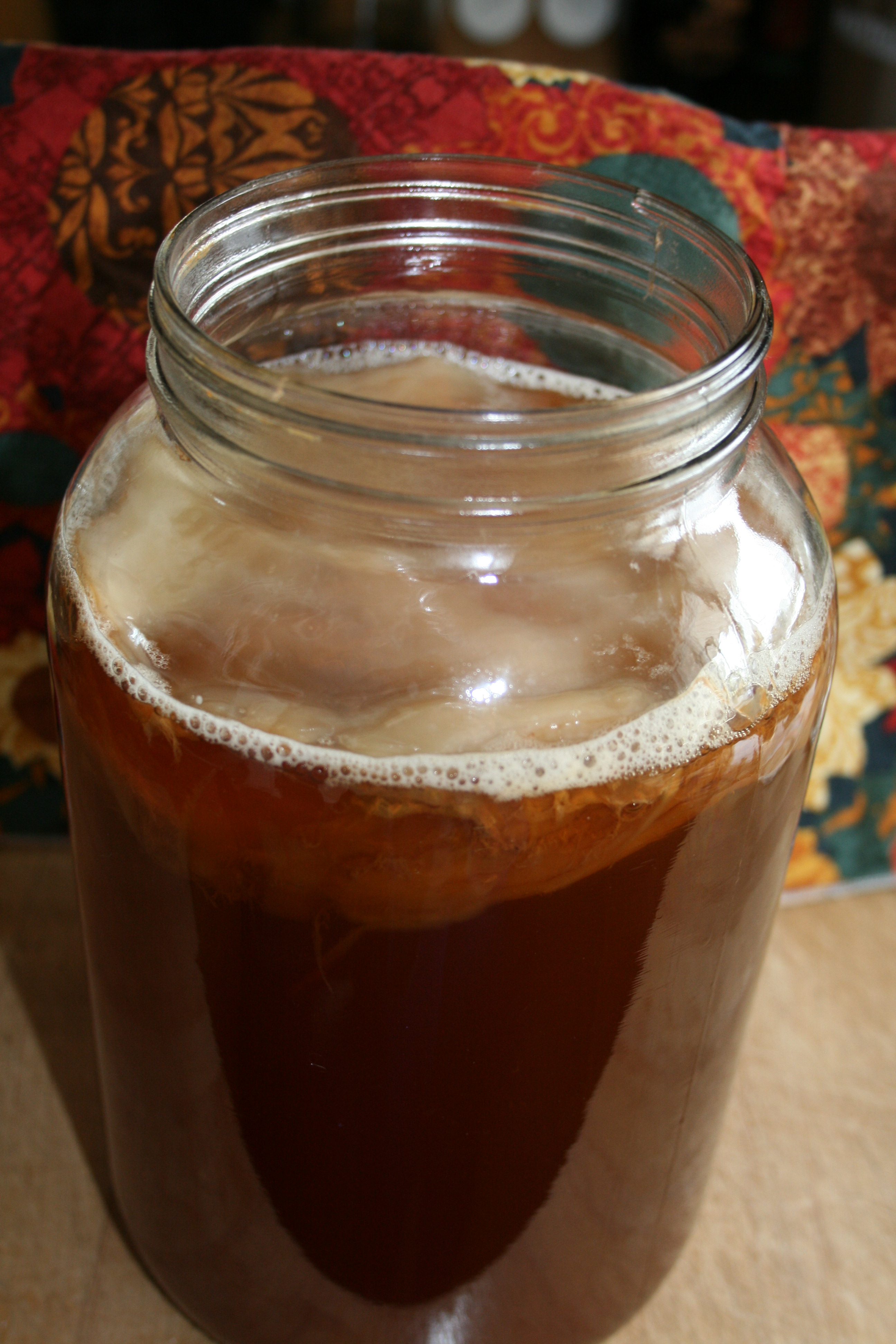
    SCOBY fermenting tea to make kombucha.

    Leave room at the top for your SCOBY to grow.

  3. Cover the container with a clean cloth, kitchen towel, or handkerchief kept in place with a rubber band.  Place the jar in a warm spot (I put mine in the oven with the oven light on) that is out of direct sunlight and where it won’t be disturbed or moved.Make sure that the cloth or towel is breathable but the weave is tight enough to keep out fruit flies, gnats, and other undesirables.Your SCOBY may sink or float on the top, both are okay.  In 2-3 days, you may see a translucent jelly like mass floating on the top of your tea.  This is a baby SCOBY beginning to form.  Leave it undisturbed so that it can grow properly.
  4. Taste your kombucha 7 or 8 days after starting it using a straw inserted down the side of the SCOBY, not through it. Ideally, kombucha should have a slightly sharp and acidic bite. How long it takes to make a batch depends on the temperature of your home and how sweet or sour you’d like it to be.  Most batches will be ready in 7-10 days.  The longer it brews, the sharper it gets.
  5. Just before you think you will be bottling your kombucha, brew another batch of sweetened black tea so it will be cooled to room temperature and ready for you to use to start the next batch using the mother or baby SCOBY and the reserved kombucha.
  6. When your kombucha is ready, pour all but the last 2 cups into clean bottles or jars, straining it as you pour to catch any tiny SCOBYs that may be starting.  Leave the mother SCOBY in the original jar while you bottle your batch. NOTE:  keeping the mother SCOBY in the original jar minimizes contact and automatically reserves the 1-2 cups of starter liquid you need for your next batch.
  7. If you have a baby SCOBY growing with the mother and you want to separate them, now is the time.  You can start a second gallon of kombucha going with the new baby or give it to a friend so they can home-brew.
  8. Start your next batch by just pouring the room temperature black tea and sugar mixture you’ve already prepared over the SCOBY and starter tea you left in the gallon jar, cover and start the brewing cycle again.

Kombucha will naturally have a slight fizziness.  To increase the carbonation and level of tartness, leave the bottled kombucha on a counter top for several days after bottling.  BURP the bottles to keep the pressure from building up and the brew from spurting out of the bottle when opened.  Keep bottles stored in a refrigerator once the brew is finished fermenting.

Once you get the rhythm – brew tea and cool it down, strain and drain kombucha into bottles for finishing, add tea to your SCOBY and start again – you’ll understand why I say it’s easy to home brew your own kombucha.

Important notes:
Always clean your hands, utensils, and anything that might touch your kombucha with hot water and distilled vinegar. Do not use soap, (especially antibacterial soap) as it may harm or kill the kombucha culture. Your kombucha is alive!  Make sure to handle it with care.

Only use lead-free glass and ceramic for fermenting. Kombucha will absorb toxins out of the container that it’s brewed in (much like how it pulls toxins out of our bodies).

SCOBYs have an unusual appearance, scent, and feel, but don’t let this discourage you! You’ll quickly grow accustomed to their odd appearance and will get used to handling them.

If the SCOBY grows mold, throw the liquid and SCOBY into the compost and begin with fresh materials.

One thing I didn’t mention is flavoring your home brew. There are any number of tasty additions including organic juice, fresh or dried fruit, berries, herbs, and spices for whatever flavor suits your mood.

And, next week, I will share some of my favorite kombucha recipes!


How To Grow Beets

Baby beets grown indoors from seed.

Beets started indoors can be transplanted outdoors as soon as you can work the soil — if you protect them from frost.

Beets are known as cool season crops.  They really like cool temperatures and can be seeded as soon as you can work the soil.  And beets are one vegetable that should be organically grown.

My mom raised the absolute best beets I have ever eaten.  Every time I drove to her farm in the far end of Virginia, she would somehow know exactly when I was arriving.  There, on the table, steam rising, butter melting, would be a big bowl of sliced beets, just for me.

But I never planted beets in my own garden, not before she died, not after she died.  Then, one day, while browsing through GrowItalian.com, I saw Chioggia beets.

Beautiful, round and ruby-red on the outside but when you cut them open, there are concentric white bands all the way through each slice. I fell in love with beets, again.

Beets Are Easy Peasy
I’ve had beets in my garden now for the last 5 years and think they are among the easiest plants to grow.  But if you Google “growing beets,” you will literally get more than 1 million entries.

Don’t be scared!

There are only a couple of things you need to know to raise not just 1 but at least 2 crops of beets every year. (That’s how many I can grow in Zone 6b.)  WARNING: if you ignore what you are about to read, you will get red marbles…that will not cook or eat easy.  I know.  My first crop was used in a game of ringer.

The Dirt
This is almost one of the only requirements of beets and it’s one of the most important.  It’s also the bit of information I didn’t have when I raised my first crop of red marbles.  Beets really, really like loose, well-drained soil. They will put up with a wide range of conditions but won’t grow as big or as beautiful.

So do a bit of soil prep if you can. It may take a bit of time and effort but it’s worth it; I know.  And if you get the soil right, it’s smooth sailing to harvest time.

Remove stones since they will hinder growth.  If you’re growing in clay, add compost to loosen the soil and keep the soil from crusting after watering or rainfall.  And make sure your soil is acidic – beets like a pH range of 6.2 to 6.8.

When To Plant
Don’t plant in the middle of your summer season.  Beets won’t like it.  They are a perfect cool weather crop.  Although they can live through the heat (like the rest of us), they prefer a temperatures of 60 to 65 F and bright sunny days but they can also survive cold weather as long as they don’t get caught in a freeze.  So, beets are a great, “long-season” crop.

How To Plant
You can (and I do) start beets indoors but beet seeds are outdoor babies from the get go.  As soon as your soil can be worked in the spring, you can plant them.  The seeds aren’t really just one seed – each of these little jewels contains a couple of beet seeds.  Sow the seeds 1/2-inch deep and I drop each seed about 3 inches away from the other seeds.  I also plant in rows about 12 inches apart.

Beets seeds are pretty slow to germinate so make sure you keep the bed moist until you see their little heads peeking out of the soil.  I usually water a bit, every day.  Once they start to pop up through the soil, I keep watering but usually every other day.

Once they are established, just make sure that you don’t let them dry out.  But don’t over water either.  Too dry or too wet and your beets will not be happy.

Transplanting
TIP:  I don’t thin; I transplant.
Most advice online and in books says you have to thin beets rather than transplant.  Wrong!

Despite what people will tell you, you can transplant beet seedlings and almost double your crop. And it’s easy to do.

I wait until the leaves on the plants are about 2 inches long before I try transplanting.  The night before the big move, I water the bed thoroughly.  Then, early in the morning, armed with a #2 pencil, I head to the raised bed where my beets live.

I look for beet plants that are too close together. Because I’m not be most patient person when dropping seeds in soil, I can usually find 3 or 4 beet babies clumped together.

DON’T PULL THEM OUT ONE BY ONE!
Once I’ve found the baby beet clump I want to move, using a tablespoon or serving spoon, I gently dig around the whole clump and bring up a spoon full of soil with the beet roots intact.  Then I push my pencil into the ground, making holes spaced about 3 inches apart, for each of the babies.

Teasing the roots apart, gently, (a trick I learned from my Amish neighbors) I drop each beet baby into its own hole, pack dirt gently around it and move on to the next clump.

I have not lost one beet baby using this method and I practically double my yield.  Oh, and beets are a twofer in my garden – I also eat beet greens in salads.  Wait until the leaves are 3 to 4 inches high, then cut a couple off each beet plant.  The beets will keep growing and you’ll have some truly delicious greens for lunch or dinner.

Care & Feeding
Like I said, beets are easy peasy.

I have never fertilized my beets and they grow like champions.  It could be because I enrich my raised beds with a bit of compost every spring.  I do put a bit of mulch – straw – down around the plants once I divide and transplant them.  It helps hold moisture during the hotter, summer days.

Keep The Beets Coming
I plant in March, April, May then hold off until early August when I start putting in seeds, again.  I do that to avoid asking the beet seeds to germinate when the daytime temperature is above 80 degrees.  They don’t like it.  Plant in early August and within 55 to 70 days, you should have your next crop.

Nowadays there are so many varieties of beet to choose from — Early Wonder, Detroit Dark Red, and Red Ace.  You can even add some color to your beet dishes with the lovely striped Chioggia (which started me on my life of beet crime) or Burpee Golden and Albino White

No matter how you slice them…beets are a great addition to any garden.

By the way, one of my favorite resources when I am trying to get solid, basic growing information is colleges like Cornell, which posted a nice guide to growing beets.

Buy butter from grass-fed, organic cows and dig in to one of my favorite dishes.

If you want fast access to all my gardening tips and tricks, you will find them in my Kindle book, Grow So Easy; Organic Gardening for the Rest of Us.

How To Grow Potatoes

Most of you know that I have had my ups and downs trying to grow potatoes.
The outcome was not very good.  I couldn’t get a straight answer on where or how to plant. Once the potato eyes were in the ground, Wireworms and Colorado Potato Beetles joined together to make for tiny tubers and a potato growing nightmare.

So,when I read High Mowing Seeds post on growing potatoes 101 I knew I had to share.

I also think that Margaret Roach of A Way To Garden fame has a good tutorial fro growing your own spuds, too.

If you dream of growing your own spuds or want to be able to walk into your back yard and dig a few potatoes for the dinner table, High Mowing Seeds and Margaret Roach can help you get it done.

Remember, potatoes love being planted when it’s cool out so early spring is a great time to give this American favorite a try.

If you are successful, try dicing a few into this fabulous fish chowder – buttery rich and tasty. I married an Italian but my maiden name was Duffy.  If I know anything, I know some great recipes for cooking potatoes!

Fish Chowder

INGREDIENTS:
2 boneless fish fillets
2 thick cut bacon slices
2 T butter
1 leek, minced
1 stalk celery, minced
½ tsp dry mustard
1 lb potatoes, peeled & cubed
4 sprigs thyme
¼ c heavy cream
1 T minced chives

DIRECTIONS:
Place fish fillets and bacon slices in large pot and cover with 4 cups cold water.

Bring to simmer over medium high heat then reduce heat to medium and simmer for 5 minutes or until fish is cooked.

Transfer fish to plate and let it cool then remove skin and flake into large pieces.

Continue to simmer bacon in broth until stock is reduced by half (2 cups).

Strain, discard bacon, add 2 to 3 cups of water and reserve poaching liquid.

Melt butter in large pot, add leeks and celery and cook 15 minutes until translucent.


Rancho Gordo Founder Spills the Beans

I love Steve Sando.

Actually, I love his beans.  Sando created, owns and runs Rancho Gordo, which is in my view, the premier vendor of heirloom beans.

Rancho Gordo bean recipes

Heirloom beans from Rancho Gordo

My first brush with Rancho Gordo came through Oprah Winfrey’s magazine, O.  It was a profile on the company, probably almost a decade ago that kicked off my love affair and I have bought Sando’s beans ever since!

In this podcast, Steve Sando shares his background, his path and how he let serendipity into his life and changed it forever.

This is a fabulous interview by Lisa Gansky, a self-acclaimed entrepreneur, social instigator, international speaker, and author, with a man who I admire and whose products I buy for myself, my daughter and my friends.

BTW – Steve Sando doesn’t just sell beans, he share his recipes, expertise and enthusiasm for growing, sourcing and eating heirloom beans!

Enjoy!

Grow A Healthy Gut in 2016 – Microbiome Resources For You!

Want to know how easy it will be to get healthy, lose weight, say good-bye to chronic complaints about digestion, headaches and other maladies and have a Happy New Year in 2016?

Read one book.  Make some changes to what you eat and start on the path to good health. That’s how easy it is.

2016 New Year of Health

Get healthy in 2016. It’s easy.

I sincerely wish I had found the book about 15 years ago when bladder cancer became out ticket to travel down the rabbit hole of so-called “health care.”

Surgeries (12), hospitalizations (52) and BCG therapy (5 courses of a form of bacterial Russian roulette that was supposed to kill the cancer cells) and up until just 3 months ago, my husband was just as unhealthy as he had been when the ride started.

For years, we had heard from his medical team that Pat’s problem was “leaky gut,” a diagnosis often delivered with a shrug and not one idea on how to change it.

So, what does our tale of woe have to do with getting healthy in 2016?
Everything.

In October, I bought Dr. David Perlmutter’s most recent book, Brain Maker, and I finally got a clear understanding of what leaky gut is and means and why it was critical to Pat’s health.

What I learned from a book (which was not, once mentioned by the cadre of specialists who have seen, treated and billed my poor husband) is that the intestinal lining – the largest mucosal surface in the body and the barrier between “the inside and outside” is exactly one single cell thick!

Bad news? If you have leaky gut it means your cell wall is permeable and you have a very serious health issue. Good news?  Leaky gut is manageable, dare one say reversible?

Not one of the idiots who had Pat in their care knew, mentioned or even touched on the criticality of this condition or the way to help fix it.  They just kept prescribing antibiotics – life-saving but also life-threatening – and sending him home.

After reading Dr. Perlmutter’s book, Brain Maker, I learned about the good bacteria that should be in the gut and those that can cause problems if they overtake the good bacteria.  I got a broad but enlightening introduction to the “second brain” and the fact that the gut often sends messages to the brain to make it act – not the other way around.

Everything I read influenced our next round of dietary changes. Dr. Perlmutter’s recipes made it easy to make the needed changes.  And suddenly things started improving for my husband.

Once I read Dr. Perlmutter’s book and implemented changes (see NOTE ON DINING below), I started doing some research on the microbiome.  This is a growing field and there is a tremendous amount of research going on under the covers on the second brain.

It appears that the world of medicine is about to change, radically and for the better. If you want more information here are some resources I recommend:

This TED talk lays a solid foundation for how our gut bacteria work and how they affect our health . Rob Knight opens the door in this TED talk then helps us walk right in by talking about how gut bacteria might be implicated in a raft of chronic health issues like Inflammatory Bowel Disease (IBD), Celiac disease, obesity, allergies, and asthma.

If you want to know what’s going on in your microbiome – a snapshot if you will – here is the place to go. Visit this crowdsourced research project and get your gut bacteria analyzed for less than $100.

It’s all there, available for anyone who wants to get their health back.

After reading, listening and changing a few more things in our lives, for the first time in 15 years, Pat and I are able to manage his infections, lower his blood sugar and give him back his life.

One book, one person changed our lives forever and for the better!

Borrow it from the library, download it from Amazon, buy it.  Sign up for Dr. Perlmutter’s regular posts, videos and information and get healthy in 2016!

Happy New Year, everyone.  Here’s to your health.

NOTE ON DINING:  As I said earlier in this novella, what the book/doctors are saying on how to correct your microbiome may seem a bit draconian if you are just getting started.  Take it one bite at a time and you will get your health back.

By the time I read this book, we had already totally cut out ALL processed foods.  We ONLY eat organic, non-GMO foods – including meat, poultry and wild-harvested fish – and fruit and veggies I either raise or get at the local organic food exchange.  That has helped both of us lose over 50 pounds and really feel physically better but it didn’t move his blood sugars a whole lot nor did it cut down on his regular trips to the hospital.

Now, he and I both eat freshly made sauerkraut (I am on my 3rd batch and enjoy making it).  Also, instead of spending $7.50 for a pint at the local farmer’s market, I make a gallon + a pint for about $1.50! It’s cabbage with salt!!  Amazing and amazingly good.

We both drink kombucha which I make and bottle and are loving it!  Again, buy it in the health food store and pay $5.00 for 12 ounces.  Make it at home and it’s about 50 cents a glass.  We recently added duck eggs to our diets – 16% more protein and said to be better at creating a gut environment that is less conducive to the growth of cancer cells.

Simple changes to our diet and a bit of knowledge about how the gut works and how critical it is to overall health could have changed our lives and saved us emotional currency, time and thousands and thousands of dollars over the last decade and a half.

I urge you to explore the concept of microbiome and gut bacteria.  Just Google it and see how many diseases are actually being studied and in some cases reversed by getting good gut bacteria to outweigh the bad – autism, ALS, ADHD, Alzheimer’s and that’s just the A’s!

AVOID GMOs – Dr. Perlmutter Adds His Voice

Merry Christmas….and here’s my gift to you.
DON’T BUY GMO foods or use RoundUp

Okay, this may not seem like an appropriate post during the holidays but what greater gift can you give yourself, your family than good health?

Growing organic veggies is easy.

Grow your own food; you’ll know where’s it’s been.

If you want to eat healthier and don’t want to grow it yourself, if you want to support local farmers and growers and walk a bit softly on the earth we call home, perhaps 2016 is the year you get started.

One of the easiest ways to begin your quest for health is to READ and decide to buy or not buy based on what the product is, what it contains and who made it.

It’s common knowledge that one of the easiest things to do is cut out GMO products – cut them out, get rid of processed foods, start buying and eating organic.

Now Dr. David Perlmutter, author of Brain Maker and Brain Game, adds his voice to those warning about GMOs but his information is a bit more frightening than any I have read before (and I have read an awful lot about this topic).

Dr. Perlmutter shares the most recent and perhaps most damning research that shows that GMOs are the tip of a very unhealthy iceberg called glyphosate.  You all know glyphosate more commonly as RoundUp.

Here’s the quote that makes me want to rant, and rave and cry…don’t buy RoundUp or any of its derivatives.  Don’t eat GMO food. “Roundup was among the most toxic herbicides and insecticides tested. Most importantly, 8 formulations out of 9 were up to one thousand times more toxic than their active principles.”

Don’t believe Dr. Perlmutter?  Read the research yourself.

Try making this your New Year’s resolution: leave the weeds alone!  Or eat them. Or pull them. Or burn them. Or pour pretzel salt and white vinegar on them.  But for your sake, your family’s sake, the planet’s sake, don’t spray them with RoundUp or any of it’s relatives.

What you spray ends up in the water table, your food, your neighbor’s kids, you.  Please, stop.  Please.

Holiday Entertaining: Recipe for Lasagna with Cabbage

My Italian born husband loves this lasagna and so do I.

Adapted from Crescent Dragonwagon‘s cookbook – The Passionate Vegetarian,Pumpkin and Bean Lasagna is rich, flavorful and, once you have the fillings assembled, easy to make.

Another plus is this lasagna is diabetic friendly!  I only use 15 (fifteen) lasagna noodles in a five pound casserole.  So my husband can enjoy exceptional flavor and not worry about his blood sugar.

Give it a try on a cool, rainy day and you may never go back to the old fashioned way of making lasagna again.

FYI – as I mentioned, this is a 5 pound lasagna — a BIG lasagna using a pan that is about 5 inches deep, 15 inches long and 12 inches wide.  After guests have had their fill, I cut whatever I have left into serving sizes and freeze it for another rainy day.

The ingredients are listed in order and, like most lasagnas, you assemble the fillings before you start to put the dish together.

Cabbage, Pumpkin & Bean Lasagna

Carmelized Garlic – 20 cloves of garlic, halved and pan fried until just golden.

Bean & Butternut Filling – 2 pounds of pumpkin (or butternut) cut into 1/2″ to 1″ pieces and pan fried under low heat until soft.  2 cups cooked kidney beans, drained. Mash the pumpkin or squash slightly and mix in the kidney beans

Cabbage – Cabbage sliced in ½ inch thick ribbons  NOTE:  I use the cabbage to take the place of most of the lasagna noodles.

Cheese Filling – 1 pound ricotta cheese, 3 raw eggs, 2 ounces cream cheese and 1 cup milk. Combine all ingredients in a food processor and mix until smooth.

Spices – Nutmeg, salt & pepper to taste.

3 cups grated Mozzarella Cheese

Whole wheat lasagna noodles – uncooked.  If using cabbage in place of noodles you will only need about 15 noodles.

Tomato or Spaghetti Sauce – I use 2 quarts in my lasagna.

Once you have all the layers ready, start assembling your lasagna the way you always do.  Cover with aluminum foil then bake at 350 degrees for about 75 minutes.  Uncover and bake for 20 to 30 minutes to let top brown a bit and release some moisture.

Let sit for about 15 minutes before you cut and serve it.

I like this dish because I can serve it and actually sit down to dinner with my guests.  Hope you like it, too.
Happy holidays to everyone!